


Quick Answer: Retailers can sell hemp-derived THC beverages legally by stocking products with ≤0.3% Delta-9 THC by dry weight, verifying batch COAs from ISO-accredited labs, meeting state licensing requirements, and enforcing 21+ age-restricted sales protocols. State laws vary significantly.
Smoke shop operators and retail buyers adding THC beverages face a compliance environment that differs materially from standard cannabinoid categories. Unlike disposable vapes or flower products, THC beverages intersect food and beverage law, hemp regulations, and state licensing frameworks simultaneously.
Non-compliant inventory creates direct business risk. State regulators in Florida seized over 155,000 non-compliant hemp product packages in a single enforcement sweep in 2025. Retailers holding unlabeled or mislabeled THC beverages face product seizure, administrative fines, and potential permit suspension.
The category’s growth makes it worth getting right. According to BDSA’s Q1 2025 market data, cannabis beverage sales reached $54.6 million in a single quarter – a 15% year-over-year increase. The Research and Markets cannabis beverage forecast shows the market growing from $809.12 million in 2025 to $906.33 million in 2026, then reaching $1.80 billion by 2032 at a 12.15% CAGR.
Key Takeaways
- Hemp-derived Delta-9 THC beverages are federally compliant under the 2018 Farm Bill when they contain ≤0.3% Delta-9 THC by dry weight – but state restrictions apply in multiple jurisdictions.
- As of March 2026, hemp-derived Delta-9 THC beverage sales remain a state-by-state issue: some states allow retail sales, others impose potency limits or restrict sales to licensed cannabis channels, and several have moved to tighter limits or bans.
- Compliant THC beverage labels must include THC mg per serving and per package, child-safety warnings, a QR code linking to a third-party COA, and an FDA disclaimer.
- Cannabis beverage sales grew 79-112% year-over-year in states like Michigan, Ohio, and Illinois in Q1 2025 (BDSA), making this one of the fastest-growing SKU categories for smoke shop buyers.
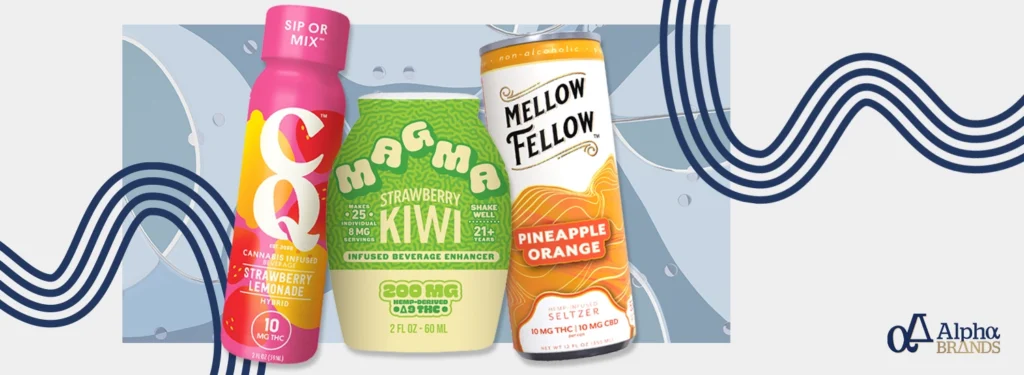
- Alpha Brands consolidates wholesale access to compliant THC beverage brands – including CQ Drinks, Mellow Fellow, Twacked Tea, and Magma – under one B2B platform, reducing sourcing and compliance complexity for retailers.
Federal Framework: How Hemp-Derived THC Beverages Stay Legal
Here’s what you need to know about the legality of hemp-derived beverages.
The 2018 Farm Bill Definition
The legal basis for selling THC beverages outside dispensaries rests on the 2018 Farm Bill, which classified hemp as any cannabis plant containing ≤0.3% Delta-9 THC on a dry weight basis. Per the USDA Agricultural Marketing Service, any cannabis plant exceeding this threshold is classified as marijuana and remains federally controlled. Products meeting the hemp threshold are removed from the Controlled Substances Act, allowing retail sales in states that permit them.
How the Dry Weight Calculation Works
For beverages, the dry weight calculation is what makes compliance achievable. A standard 12-ounce canned beverage weighs roughly 354 grams. A product containing 10mg of Delta-9 THC calculates to approximately 0.003% Delta-9 THC by weight – well under the 0.3% threshold. This formulation approach is standard across compliant THC beverage brands.
The FDA Adulteration Complication
There is a critical federal caveat retailers must understand. The FDA considers adding hemp-derived cannabinoids to food and beverages a violation of the Federal Food, Drug, and Cosmetic Act, classifying such products as “adulterated.” As Sovos ShipCompliant’s legal compliance analysis explains, this prohibition applies even to CBD- and Delta-9-infused beverages.
In practice, federal enforcement against compliant, properly labeled hemp beverages has remained limited at the state retail level – but the regulatory tension is real. The Shutdown Fairness Act of November 2025 included provisions restricting hemp-derived THC products federally. Retailers should monitor federal developments closely and consult legal counsel for jurisdiction-specific guidance before expanding into this category.
Grow your beverage category with compliant Delta-9 THC drinks available through Alpha Brands.

State-Level THC Beverage Laws: What Retailers Must Verify Before Stocking
States have taken three distinct positions on hemp-derived THC beverages:
- Permissive States allow retail sales with standard hemp licensing and standard potency
- Restricted States impose potency caps, require specialized licensing, or limit sales channels
- Ban States prohibit intoxicating hemp products entirely regardless of THC content

| State | Delta-9 THC Beverage Status | Key Restrictions |
| Alabama | ✅ Legal (licensed) | 21+, max 10mg/serving, 40mg/package; ABC Board licensing required. |
| Alaska | ❌ Banned | Intoxicating hemp products prohibited. |
| California | ⚠️ Restricted | Alcohol-licensed businesses barred from selling hemp THC beverages. |
| Florida | ✅ Legal (regulated) | Child-resistant packaging + QR code COA mandatory; state compliance rules apply. |
| Hawaii | ❌ Banned | All intoxicating hemp products prohibited. |
| Idaho | ❌ Banned | Zero detectable THC — no hemp THC products of any kind permitted. |
| Illinois | ✅ Legal | Generally permitted under hemp/food compliance rules; many THC beverages are also sold through cannabis channels. mellowfellow |
| Massachusetts | ❌ Banned | ABCC prohibits THC and CBD-infused beverages. |
| Minnesota | ✅ Legal | Among the most permissive states; still a major legal market for hemp-derived THC beverages. frierlevitt+1 |
| Montana | ⚠️ Restricted | Very low potency caps limit most commercial products. |
| New Jersey | ⚠️ Restricted | Intoxicating hemp beverages face new 2026 restrictions; beverage sales will move under tighter limits, with a November 2026 transition for some provisions. nj+1 |
Note: State laws change frequently. Verify current status with local legal counsel before placing wholesale orders for any jurisdiction.
Interstate Shipping Restrictions
Retailers managing multi-state distribution or online sales face additional restrictions. Per Sovos ShipCompliant’s shipping compliance guide, USPS permits hemp product shipments at ≤0.3% Delta-9 THC with COA documentation.
FedEx and UPS allow hemp-derived products with additional compliance measures but restrict business-to-consumer shipments in various circumstances. Products cannot legally be shipped to ban states regardless of federal compliance status.
THC Beverage Labeling Requirements: What Must Appear on Every Package
Label compliance is the single most common point of failure for retailers receiving inventory from unvetted suppliers. Buyers must verify every required element before putting products on shelves.
Mandatory Label Elements
Per the Hemp Beverage Alliance’s industry labeling principles and state-level requirements, compliant labels must include:
- Hemp Compliance Statement: “Hemp-Derived Product – Contains Less Than 0.3% Delta-9 THC (Dry Weight Basis)”
- Potency Disclosure Per Serving and Per Package: e.g., “10mg Delta-9 THC per serving | 40mg per package”
- Age Restriction: “21+ Only” and “Keep Out of Reach of Children”
- FDA Disclaimer: Product has not been evaluated by the FDA for safety or efficacy
- COA Access: Scannable QR code or URL linking to a current third-party Certificate of Analysis, including the batch number
- Manufacturer Information: Name, address, and phone number of the manufacturer, packer, or distributor
- State-Specific Warnings: Additional language required in states like Maryland, Georgia, and Florida
Serving Size Rules
Per Hemp Beverage Alliance standards, serving sizes must be expressed in milligrams of THC content – not standard beverage volume. A label stating “1 can = 1 serving” without specifying THC milligrams fails compliance. The Alliance also sets a 10mg Delta-9 THC per container standard for responsible serving limits.
Packaging Requirements by State
| Requirement | Federal Standard | Florida (Rule 5K-4.034) | Alabama | Maryland |
| Child-resistant closure | Recommended | Mandatory (June 2025) | Mandatory | Mandatory |
| Tamper-evident seal | Recommended | Mandatory | Mandatory | Mandatory |
| No child-appeal packaging | Recommended | Mandatory | Mandatory | Mandatory |
| QR code to COA | Industry standard | Mandatory | Required | Mandatory |
| 21+ age warning | Industry standard | Mandatory | Mandatory | Mandatory |
Lab Testing Standards: What COAs Must Show
COAs are used to ensure that products meet standards. Here’s what they have to show:
ISO 17025 Accreditation Requirement
Products must be tested by an ISO 17025-accredited third-party laboratory to verify Delta-9 THC concentration by dry weight. The USDA AMS hemp production rules require labs testing hemp for compliance to maintain DEA registration in addition to accreditation. Most regulated states extend this requirement to finished product testing.
What a Compliant COA Must Show
Retail buyers should verify that every COA from a wholesale beverage supplier includes:
- Delta-9 THC percentage by dry weight (must be ≤0.3%)
- Milligram potency per serving and per package (must match label)
- Full cannabinoid panel including CBD, CBG, and minor cannabinoids
- Contaminant testing: heavy metals, pesticides, residual solvents, microbials
- Batch number matching the number printed on the product packaging
- Lab name and ISO 17025 accreditation status
- Test date (COAs older than 12 months should be treated with caution)

Wholesale THC Beverages: Supplier Evaluation Criteria
Retail buyers adding THC beverages to inventory need supplier due diligence that goes beyond standard cannabinoid sourcing. The ingestible format and intersecting food regulations create additional verification requirements.
| Evaluation Criterion | What to Verify | Why It Matters for Retailers |
| COA Accessibility | Batch-level COA via QR code on every unit | Confirms ≤0.3% Delta-9 by dry weight; required by most states for retail display |
| ISO Lab Accreditation | Lab name and ISO 17025 status on COA | Ensures testing reliability in the event of regulatory inspection |
| Potency Accuracy | Stated mg/serving matches COA results | Mislabeled potency creates consumer safety liability and state enforcement risk |
| Child-Resistant Packaging | CR closures and tamper-evident seals present | Mandatory in most regulated states as of 2025 |
| State Distribution Eligibility | Supplier confirms ship-to states and restrictions | Prevents receiving inventory that cannot legally be sold in your state |
| Shelf Stability | Expiration or best-by date visible on label | Required by most state hemp food and beverage regulations |
| Serving Size Disclosure | mg of THC per serving clearly stated, not just volume | Industry standard per Hemp Beverage Alliance; required by several states |
THC Beverage Products Available Through Alpha Brands Wholesale
Alpha’s beverage catalog covers the dose ranges and format types that drive consumer velocity in retail environments. BDSA consumer research shows 42% of edible consumers prefer dosages of 10mg or less per occasion, with strawberry lemonade, fruit punch, and tea-style flavors ranking among the top-performing beverage formats.
Available SKUs Through Alpha’s Wholesale Platform

- Twacked Tea 1pc Beverage 20mg Delta-9 THC + CBD Cross Fade (Lemonade Sweet Tea) 4 CT – A 20mg Delta-9 + CBD blend in a familiar iced tea format. The cross-fade formulation appeals to consumers seeking balanced effects; the 4-count retail pack supports impulse and repeat purchases.
- Mellow Fellow Mixers 10pc Beverages 10mg Delta-9 + CBD + CBG Pomegranate Ginger Mojito – Mellow Fellow’s 10-count mixer format delivers a 10mg Delta-9 + CBD + CBG blend. The multi-cannabinoid profile and cocktail-style flavor support premium shelf positioning and higher average transaction values.
- Mellow Fellow Seltzer Beverages 20mg Delta-9 + CBD Pineapple Orange 4ct – A 20mg Delta-9 + CBD seltzer in a 4-count format. Seltzer formats align with the “sober curious” consumer trend driving strong year-over-year beverage category growth.
- CQ Drinks Cannabis Infused Beverage 10mg Delta 9 Strawberry Lemonade (Hybrid) 24ct – CQ Drinks’ 24-count case format is built for smoke shop volume buyers. Strawberry lemonade ranks as a top-selling THC beverage flavor according to BDSA category data.
- CQ Drinks Cannabis Infused Beverage 10mg Delta 9 Old Fashioned Lemonade (Sativa) 24ct – A sativa-positioned 10mg Delta-9 option in a 24-count case. Strain-typed beverages support consumer self-selection and reduce counter education burden for retail staff.
- Magma Infused Beverage Enhancers 200mg Delta 9 Strawberry Kiwi 6 CT – Magma’s beverage enhancer format differentiates from standard canned beverages, allowing consumers to add Delta-9 to any drink. The 200mg total / 6-count format drives a higher per-unit price point with strong margin potential.
Retailers sourcing compliant THC beverages wholesale should also review Alpha’s full edibles and beverages category for current SKU availability.
Age Verification and Point-of-Sale Compliance
Most states require buyers to be 21 or older for any intoxicating hemp product, aligning with alcohol sale standards. A minority of states set thresholds at 18 for hemp products – but 21 is the safe operational default for any retailer carrying THC beverages.
Required Operational Protocols
Retailers carrying THC beverages should implement the following at point of sale:
- Valid government-issued ID verification for every purchase (same protocol as alcohol)
- Staff training on recognizing valid ID formats, spotting fakes, and handling refusals
- POS system age-restriction flags on all THC beverage SKUs to prompt ID checks at checkout
- Compliance documentation on file covering age verification procedures for use in regulatory audits
Retailers adding THC beverages should review their existing vape shop license requirements and hemp product permits, as some states treat THC beverages under separate licensing from smokable products. For multi-category operators, Alpha’s cannabis B2B platform guide covers wholesale sourcing considerations specific to smoke shops managing multiple regulated categories.

How Alpha Brands Supports THC Beverage Compliance for Wholesale Buyers
Managing THC beverage compliance across multiple brands and shifting state regulations creates documentation and sourcing complexity. For smoke shops already managing 50+ SKUs, adding a new ingestible category multiplies vendor relationships and COA tracking requirements.
Alpha Brands consolidates wholesale access to compliant THC beverage brands – alongside cannabinoid, kratom, and nicotine categories – under one wholesale relationship. Instead of managing separate supplier accounts for each beverage brand, retail buyers access batch-tested, retail-ready inventory through a single platform with centralized COA access.
For more guidance on product compliance and inventory sourcing, see Alpha’s out-of-compliance cannabis wholesale guide and the best hemp brands for retailers post. Retailers evaluating whether to expand into beverages alongside existing categories can also reference Alpha’s guide to placing products in retail stores for broader inventory strategy context.
Find compliant THC beverage brands and wholesale-ready inventory through Alpha Brands.
Frequently Asked Questions
Are THC Beverages Legal to Sell in Smoke Shops?
Yes, in states that permit hemp-derived products. Hemp-derived Delta-9 THC beverages with ≤0.3% Delta-9 THC by dry weight are federally compliant under the 2018 Farm Bill and can be sold in retail environments – including smoke shops – in states that allow them.
What Is the Legal THC Limit for Hemp Beverages?
Federal law under the 2018 Farm Bill sets the threshold at ≤0.3% Delta-9 THC by dry weight, per the USDA AMS. For a standard 12-ounce beverage, this allows for approximately 10mg of Delta-9 THC per container. Some states impose lower limits – Montana caps Delta-9 beverages at 0.5mg per serving and 2mg per container, per the Marijuana Herald’s state-by-state breakdown.
What Licenses Are Required to Sell THC Beverages?
Licensing requirements vary by state. Some require a hemp retailer permit or specific hemp beverage endorsement. Others regulate THC beverages under existing food handler or tobacco retail licenses. Retailers should check with their state’s department of agriculture or alcoholic beverage control agency for current requirements. Sovos ShipCompliant’s compliance guide notes that in some jurisdictions, dual licensing with an alcohol permit on the same premises is prohibited.
What Lab Testing Is Required for THC Beverages Sold at Retail?
Products must be tested by an ISO 17025-accredited third-party laboratory to verify Delta-9 THC concentration by dry weight, full cannabinoid profile, and absence of contaminants. Per the USDA hemp program requirements, testing labs must maintain DEA registration. COA results must be batch-specific and accessible via QR code or URL on product packaging in most regulated states.
Why Does the FDA Prohibit Adding THC to Food and Beverages?
The FDA considers adding THC or CBD to food or beverages a prohibited act under the Federal Food, Drug, and Cosmetic Act, classifying such products as “adulterated.” This position stems from THC and CBD being active drug ingredients without approved food additive status. Despite this federal stance, enforcement at the state retail level has remained limited for compliant hemp beverages – but the position creates legal exposure that retailers should understand.
What Are the Penalties for Selling Non-Compliant THC Beverages?
Penalties vary by state. Maryland sets fines up to $5,000 per violation for unlicensed sales. In Florida, the 2025 enforcement sweeps reported by Cannabis Regulations AI resulted in seizure of 155,000+ non-compliant packages across 40 counties in a single summer. Additional penalties can include permit suspension, criminal charges for repeat violations, and mandatory product destruction at the retailer’s cost.
How Do THC Beverage Labeling Requirements Differ From Edible Gummies?
THC beverage labeling follows the same core requirements as other ingestibles – COA QR code, THC mg per serving and per package, 21+ age warning, FDA disclaimer – but with additional beverage-specific rules. Per the Hemp Beverage Alliance labeling principles, serving size must be expressed in THC milligrams rather than beverage volume. Packaging must also be child-resistant, tamper-evident, and cannot resemble consumer food products likely to attract children – a rule now enforced in Florida, Alabama, Georgia, and others.
Legal Disclaimer
This article provides general information about hemp and cannabinoid beverage regulations for educational purposes. It does not constitute legal advice and should not be relied upon as legal counsel for specific business decisions. Hemp and cannabinoid laws change frequently at federal, state, and local levels. Retailers should consult qualified attorneys before making compliance decisions. Alpha Brands provides compliance documentation support but does not offer legal advice. Always verify current regulations in your specific jurisdiction before stocking or selling hemp-derived THC beverages.
Sources
- | Florida’s 2025 Hemp Bills: THC Beverage Limits, New Taxes, and Synthetic Bans Explained
- Legal Status of Hemp-Derived THC Products in All 50 States (November 2025)
- The future of beverage is hemp-infused
- Cannabis Beverages Market Size, Share & Forecast to 2032
- 2025 Cannabis Beverage Market: BDSA Insights of Emerging Trends & Top Brands
- Hemp-Derived Beverages: Legal Compliance State-by-State Guide – Sovos ShipCompliant
- FDA Concludes that Existing Regulatory Frameworks for Foods and Supplements are Not Appropriate for Cannabidiol, Will Work with Congress on a New Way Forward | FDA
- Frequently Asked Questions (FAQ) | Agricultural Marketing Service
- Hemp | USDA